

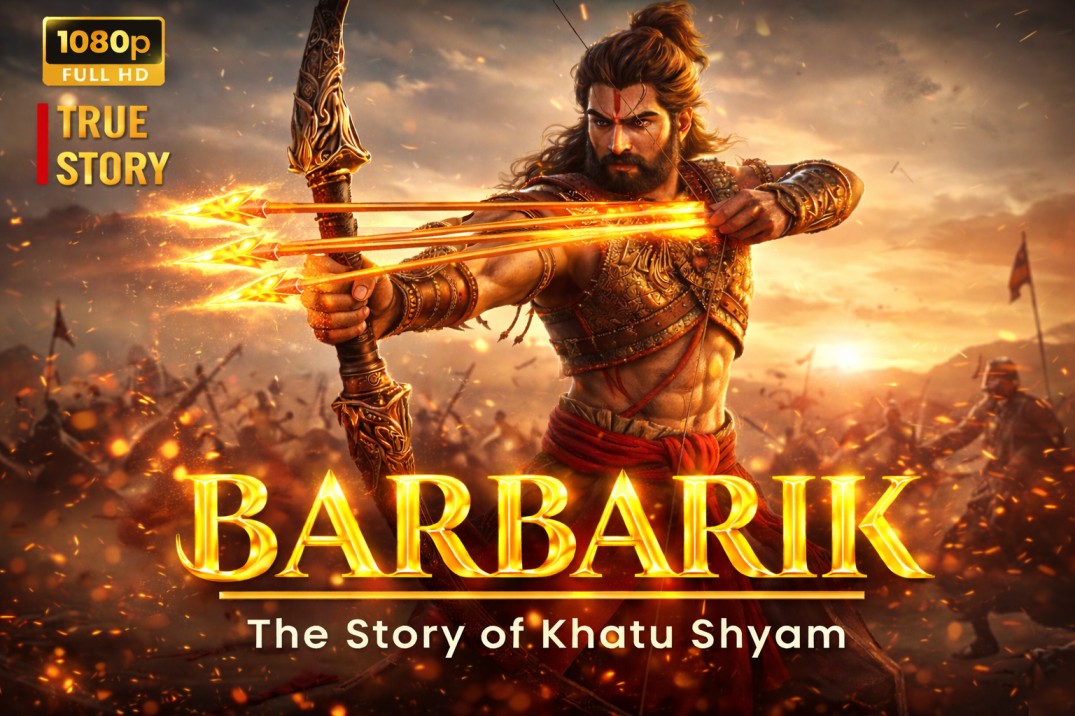
The Legend of Khatu Shyam Ji: In the modern age of stress and competition, millions find solace in a single phrase: “Haare Ka Sahara, Shyam Hamara” (The support of the defeated is our Shyam). But who is Khatu Shyam Ji? Why is a warrior from the Mahabharata worshipped as a god in the Kaliyuga?
This is the epic story of Barbarik, the grandson of Bhima, and his journey from a powerful warrior to the “God of the Defeated.”
1. The Warrior with Three Infallible Arrows
[02:19] Barbarik was the son of Ghatotkacha and the grandson of the Pandava Bhima. He was an extraordinary warrior who possessed three special arrows given to him by Lord Shiva [02:37].
- The First Arrow: Marked all the targets he wanted to destroy.
- The Second Arrow: Marked all the targets he wanted to save.
- The Third Arrow: Destroyed the marked targets and returned to his quiver.
With these three arrows, Barbarik had the power to end the entire Mahabharata war in just a few minutes.
2. The Vow to Support the Loser
[03:02] Before leaving for the Kurukshetra war, Barbarik made a noble yet dangerous promise to his mother: “I will fight for whichever side is losing.” Lord Krishna realized the paradox of this vow [03:18]. If Barbarik joined the losing Kauravas, the Pandavas would start losing. If he then switched to the Pandavas, the Kauravas would start losing again. This would result in the total annihilation of both armies, leaving no one alive to establish Dharma.
3. The Ultimate Sacrifice: The Charity of the Head
[03:44] Disguised as a Brahmin, Lord Krishna tested Barbarik’s skill by asking him to pierce every leaf on a Peepal tree with one arrow [04:19]. Barbarik succeeded, even marking a leaf Krishna had hidden under his foot [04:34].
Realizing Barbarik’s invincible power, Krishna asked for a difficult gift (Daan): Barbarik’s head. Without a moment’s hesitation, Barbarik agreed, but he had one final wish—to witness the entire Mahabharata war [05:32].
4. The Witness of the War
[06:08] Krishna placed Barbarik’s severed head on a high hill overlooking the battlefield of Kurukshetra. From this vantage point, the head remained alive and witnessed every strategy, sacrifice, and victory [06:37].
After the war, when the Pandavas argued about who was responsible for the victory, Barbarik’s head spoke the ultimate truth: “It was only the Sudarshana Chakra of Krishna that won the war; all others were merely instruments” [09:40].
5. The Blessing of Kaliyuga: Becoming Khatu Shyam
[09:50] Impressed by his supreme sacrifice and humility, Lord Krishna gave Barbarik a boon: In the age of Kaliyuga, he would be worshipped in Krishna’s own name—Shyam.
He declared that anyone who is defeated, broken, or hopeless would find refuge in him. Thus, Barbarik became Khatu Shyam Ji, the deity of the famous Khatu temple in Rajasthan [11:52].
Why Millions Visit Khatu Today
[14:12] Today, devotees travel miles, often barefoot, carrying colorful flags (Nishans) to see the “Sheesh Ke Daani” (The Giver of the Head).
- The Difference between Krishna and Shyam: In the Dvapara Yuga, Krishna was the strategist; in Kaliyuga, Shyam is the emotion [15:18]. Krishna leads you to victory; Shyam holds you when you lose.
- The Miracle of Faith: Shyam doesn’t always change your circumstances; He changes your perspective, giving you the strength to face any storm [15:08].
Watch the Full Video Narrative:
Khatu Shyam Ji Story: Barbarik’s Epic Sacrifice in Mahabharata
Final Reflection: Barbarik taught the world that surrender is greater than strength. If you ever feel like you are losing the battle of life, remember the words that echo through the sands of Rajasthan: “Haare Ka Sahara, Shyam Hamara.”
Jai Shri Shyam!
SEO Keywords: Khatu Shyam Ji, Barbarik Story, Mahabharata, Krishna and Barbarik, Sheesh Ke Daani, Rajasthan Temples, Haare Ka Sahara, Hindu Mythology.
