

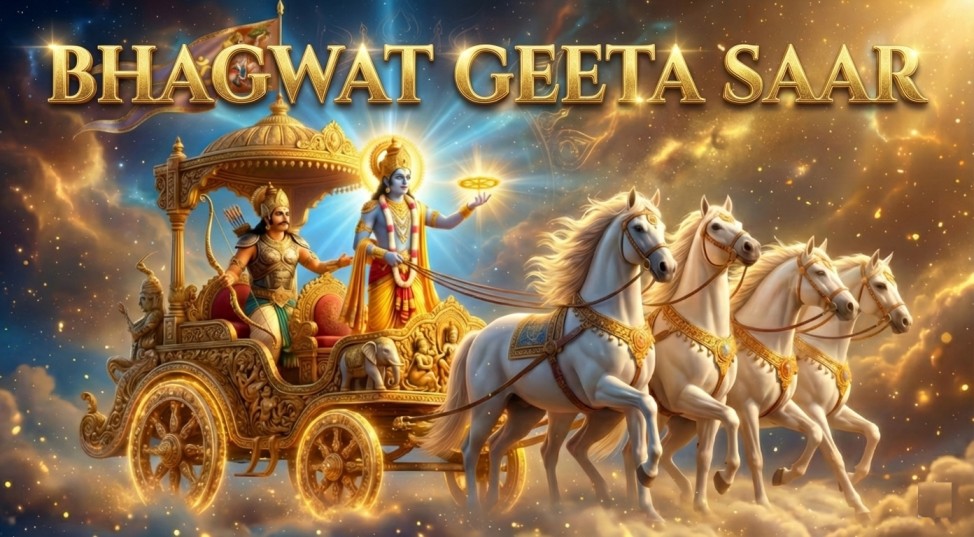
In a world racing toward fleeting distractions, the Bhagavad Gita stands as an eternal beacon, offering profound guidance on navigating life’s inner and outer battles. Composed as a dialogue between Lord Krishna and the warrior Arjuna amid the epic Mahabharata war, this sacred text transcends religion—it’s a blueprint for ethical living, mental resilience, and spiritual awakening. If you’re seeking a deeper dive than quick overviews but without committing to the full 700 verses, this 1-hour Geeta Saar video is your gateway.
Drawing from the comprehensive YouTube video भगवद गीता सार | Geeta Saar in Hindi – Complete Summary in 1 Hour | All 18 Chapters by BhaktiSwaram Production, this blog post translates and expands its essence into English. Perfect for beginners, busy professionals, or lifelong seekers exploring Bhagavad Gita summary in Hindi with accessible insights. We’ll follow the video’s timestamped structure for easy navigation, blending Krishna’s timeless teachings on Karma Yoga, Bhakti Yoga, and beyond.
Why This 1-Hour Geeta Saar Matters in 2025
- Holistic Life Lessons: From conquering the mind to selfless action, it equips you for modern stresses like work burnout or existential doubts.
- Concise Yet Deep: Covers all chapters without fluff—ideal for a single sitting.
- SEO Boost: Target phrases like “Geeta Saar Hindi summary,” “Bhagavad Gita 18 chapters explained,” and “Krishna’s teachings for daily life” to draw spiritual searchers.
Ready to embark on this divine journey? Let’s unpack each chapter’s core wisdom.
Chapter Breakdown: Following the Video’s Timestamps
Intro to Bhagavad Gita (00:06)
The Gita unfolds on the Kurukshetra battlefield, mirroring our internal conflicts. Arjuna’s crisis of conscience—fighting kin for duty—highlights the human struggle. Krishna steps in as the ultimate counselor, urging us to view life as a “war” where dharma (righteousness) triumphs.
Key Insight: The Gita isn’t about physical war; it’s your guide for moral and spiritual warfare.
Chapter 1: Arjuna Vishada Yoga – Arjuna’s Dejection (03:14)
Arjuna surveys the enemy lines filled with loved ones and gurus, gripped by sorrow. He drops his bow, questioning the ethics of violence. This sets the stage for Krishna’s intervention.
Key Takeaway: Despair is universal; it’s the catalyst for seeking higher truth. Face your fears head-on.
Chapter 2: Sankhya Yoga – The Yoga of Knowledge (06:23)
Krishna reveals the soul’s immortality: The body perishes like old clothes, but the Atman endures. He introduces Sankhya (analytical knowledge) and urges nishkama karma—action without attachment to results.
Key Takeaway: “Karmanyevadhikaraste ma phaleshu kadachana” (2.47)—Your right is to work alone, not to its fruits. Equanimity in success and failure is true wisdom.
Chapter 3: Karma Yoga – The Yoga of Action (08:59)
Arjuna ponders renunciation vs. engagement. Krishna counters: Inaction breeds delusion; perform duties selflessly as an offering. Conquer senses, shun envy, and rise above anger.
Key Takeaway: Nature demands action—do your part in the cosmic play without ego.
Chapter 4: Gyan Karma Sanyasa Yoga – Knowledge and Renunciation of Action (10:59)
Krishna shares his avatars and the purifying fire of knowledge, which eradicates past karma. Seek gurus for divine insight; even the wise act to inspire others.
Key Takeaway: Knowledge isn’t passive—it’s a tool to transform ordinary deeds into sacred ones.
Chapter 5: Karma Sanyasa Yoga – Renunciation of Action (13:57)
Both renunciation and disciplined action lead to the divine, but Karma Yoga suits the masses. The enlightened see oneness in all, achieving samatva (even-mindedness).
Key Takeaway: True renunciation is mental—drop desires, not responsibilities.
Chapter 6: Dhyana Yoga – The Yoga of Meditation (15:55)
Krishna details yogic discipline: Balanced habits, a serene space, and steady focus on the divine. The self-mastered yogi finds bliss beyond senses.
Key Takeaway: Tame the mind through practice; it’s your greatest ally or foe (6.5-6).
Chapter 7: Gyan Vigyan Yoga – Knowledge and Realization (18:58)
The divine manifests in material (Prakriti) and spiritual realms. Rare souls pierce Maya (illusion) via devotion, recognizing God in everything.
Key Takeaway: Bhakti fused with knowledge unlocks the universe’s secrets.
Chapter 8: Akshar Brahma Yoga – The Imperishable Brahman (21:33)
At death, remembrance of the divine determines rebirth or liberation. Chant Krishna’s name constantly for the highest path.
Key Takeaway: Your final thoughts shape eternity—cultivate divine awareness now.
Chapter 9: Raj Vidya Raj Guhya Yoga – Royal Secret (24:19)
This “king of knowledges” affirms God’s impartial grace: Even sinners find redemption through unwavering devotion.
Key Takeaway: Offer all to the divine; purity follows sincere surrender (9.30).
Chapter 10: Vibhuti Yoga – Divine Glories (27:10)
Krishna enumerates his opulences—the sun’s brilliance, kings’ valor—proving his omnipresence in creation’s finest forms.
Key Takeaway: See the divine in excellence; it deepens faith.
Chapter 11: Vishwarupa Darshana Yoga – Universal Form (30:34)
Arjuna witnesses Krishna’s cosmic vision: Infinite mouths devouring time. Overwhelmed, he seeks the gentle form, vowing eternal devotion.
Key Takeaway: The divine is vast and terrifying—bhakti brings it to the heart.
Chapter 12: Bhakti Yoga – The Yoga of Devotion (33:33)
Devotees offering love without expectation are supreme yogis. Cultivate equanimity, forgiveness, and non-attachment.
Key Takeaway: Bhakti is accessible—surrender with a pure heart trumps rituals.
Chapter 13: Kshetra Kshetragya Vibhaga Yoga – Field and Knower (35:42)
The body is the “field” (Kshetra); the soul, its knower (Kshetragya). Humility and discrimination free you from bondage.
Key Takeaway: Know thyself—distinguish matter from spirit.
Chapter 14: Gunatraya Vibhaga Yoga – The Three Gunas (37:46)
Sattva (purity), Rajas (passion), Tamas (ignorance) bind the soul. Transcend them via devotion for liberation.
Key Takeaway: Elevate to sattva, then beyond for true freedom.
Chapter 15: Purushottama Yoga – The Supreme Person (39:23)
The world is an upside-down Ashwattha tree—cut its roots of attachment to reach the imperishable Purushottama.
Key Takeaway: The Supreme is beyond transient and eternal realms.
Chapter 16: Daivasura Sampad Vibhaga Yoga – Divine vs. Demonic (40:38)
Divine qualities (fearlessness, truth) lead to moksha; demonic (pride, lust) to ruin. Choose wisely.
Key Takeaway: Character is karma—nurture the divine within.
Chapter 17: Shraddhatraya Vibhaga Yoga – Threefold Faith (42:59)
Faith shapes food, sacrifice, and austerity by gunas. Sattvic paths yield harmony and truth.
Key Takeaway: Align your shraddha (faith) with purity for authentic growth.
Chapter 18: Moksha Sanyasa Yoga – Liberation Through Renunciation (44:29)
Krishna concludes: Surrender all dharmas to him for sin’s dissolution and eternal peace.
Key Takeaway: “Sarva-dharman parityajya mam ekam sharanam vraja” (18.66)—Total surrender is the ultimate key.
Outro & Key Takeaways (46:36)
The video wraps with a call to internalize the Gita: Remember Krishna in your “battles,” chant for peace, and live these truths.
Core Lessons from This Geeta Saar
| Theme | Essence | Modern Application |
|---|---|---|
| Karma Yoga | Selfless action | Tackle work deadlines without obsessing over promotions. |
| Bhakti Yoga | Loving devotion | Build daily gratitude rituals for emotional balance. |
| Gyan Yoga | Discriminative wisdom | Journal to separate ego from true self during tough decisions. |
| Dhyana Yoga | Mind control | 10-minute meditations to reduce anxiety in 2025’s fast pace. |
| Moksha | Liberation | Surrender worries to a higher power for inner freedom. |
These distill the Gita’s power into actionable steps.
Dive Deeper with the Original Video
Experience the soothing Hindi narration and visuals firsthand: <iframe width=”560″ height=”315″ src=”https://www.youtube.com/embed/0Dsnm3UNnJI” title=”YouTube video player” frameborder=”0″ allow=”accelerometer; autoplay; clipboard-write; encrypted-media; gyroscope; picture-in-picture; web-share” referrerpolicy=”strict-origin-when-cross-origin” allowfullscreen></iframe>
Embrace the Gita’s Wisdom Today
This Geeta Saar isn’t just a summary—it’s an invitation to transform. Which chapter sparks your curiosity? Drop a comment below, subscribe for more soul-stirring content, and share with a friend in doubt. In Krishna’s words, victory awaits the steadfast soul.
Hare Krishna! Radhe Radhe!
